Inside TB Properties Buys Land Series
A road next to your property doesn’t automatically mean your property has legal access.
Imagine finding a beautiful piece of vacant land in Polk County, TX. You pull up the aerial map, see a road running alongside the property, and assume getting to the land won’t be a problem.
But there’s an important question:
Does the property actually have legal access to that road?
It’s a detail that can make a major difference when buying or selling vacant land.
At TB Properties Buys Land, access is one of the factors we consider when evaluating a property for a potential direct purchase. A parcel may look accessible on a map but present questions that require additional research.
Whether the property is in Polk County, TX, a rural county in Texas, or somewhere else in the United States, understanding the difference between road frontage, practical access, and legally established access is important.
Let’s break it down.
1. Visible Road Frontage: What Does the Map Show?
Road frontage generally refers to a property sharing a boundary with a road.
When looking at an aerial image or parcel map, we may see a road running directly along one or more sides of a property. At first glance, that can appear to be a positive feature.
Road frontage can make a parcel easier to identify and may provide a more straightforward route for potential access.
However, visible road frontage doesn’t necessarily establish that the owner has the legal right to use that road to reach the property.
For example:
- A parcel may appear to touch a public road on an online map.
- A road shown on a map may be private rather than public.
- The mapped parcel boundary may not accurately reflect the property’s surveyed boundary.
- A road or path may exist physically without a documented right of access.
This is why we don’t rely on an aerial image alone when evaluating road frontage.
The map gives us a starting point. Additional research helps us understand what that frontage actually means.
2. Practical Access: Can Someone Physically Reach the Property?
Even when a property has a route to it, that doesn’t automatically mean the route is practical.
Practical access considers whether someone can physically get to the property and whether the route is reasonably usable.
Depending on the parcel, we may consider:
- Is there an existing road, driveway, or established path?
- Is the route paved, gravel, dirt, or unimproved?
- Is the road maintained?
- Is the terrain difficult to navigate?
- Are there gates, fences, drainage features, or other physical obstacles?
- Can a typical vehicle reach the property, or would specialized equipment be necessary?
Consider two parcels in rural Polk County, TX.
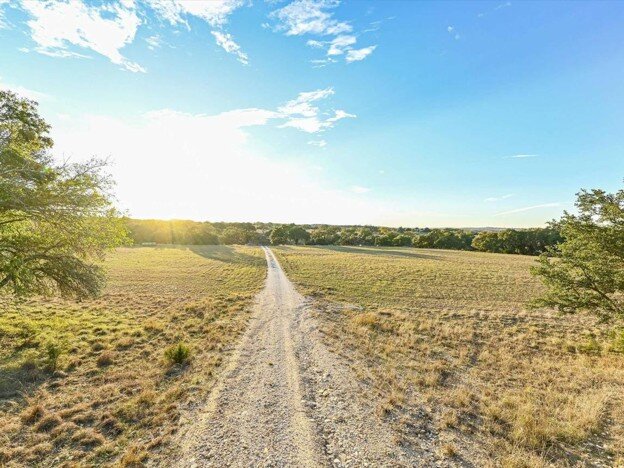
The first has a visible gravel road leading directly to the property. The second appears to have a route on a map, but the route is heavily wooded, difficult to navigate, or potentially impassable during certain weather conditions.
Both properties may have some form of access, but their practical usability could be very different.
This distinction matters because buyers often want to know not only whether they have a right to reach the land, but whether they can reasonably get there and use it.
3. Legally Established Access: Does the Owner Have the Right to Get There?
This is where things can become more complicated.
Legal access refers to having a legally recognized right to reach a property from a public road or through another authorized route.
That right may exist through direct frontage on a public road or through a recorded easement or another legally established arrangement.
An easement generally gives someone certain rights to use another person’s property for a specific purpose, such as reaching their own land. The scope and terms of an easement matter.
For example, a parcel may not touch a public road but may have a recorded access easement crossing a neighboring property.
On the other hand, a parcel may appear to have a road nearby but have no documented right to use the road or cross the land between the road and the property.
When evaluating a parcel in Polk County, TX, or anywhere else in the country, we may need to look beyond the map and examine relevant property documents.
Depending on the circumstances, that research may include:
- Recorded deeds and legal descriptions
- Recorded easements
- Title records and title commitments
- Surveys and plats
- Other documents establishing access rights
The specific requirements and legal implications can vary by state, county, and property.
The important point: Physical access and legal access are two different things.
A path someone has been using for years doesn’t necessarily establish a permanent legal right to use it. Likewise, an established easement may provide legal access even if the route isn’t obvious from an aerial image.
4. What Happens When a Property Has No Clear Access?
A property without clearly established access isn’t necessarily worthless or impossible to sell.
However, uncertainty about access can affect its marketability and the number of buyers willing to consider it.
Some buyers may be comfortable researching complicated access situations. Others may not want to take on the additional work, expense, or uncertainty.
Depending on the property, access concerns may:
- Limit the number of potential buyers.
- Make certain uses of the property more difficult.
- Require additional legal research or documentation.
- Create delays during due diligence or closing.
- Affect the price a buyer is willing to offer.
For a direct land buyer, these considerations are part of understanding the property and determining whether the purchase makes sense.
At TB Properties Buys Land, we want to understand access issues before moving forward—not discover an important limitation after a transaction is already underway.
5. Why Access Matters When We Make a Direct-Buy Offer
When we evaluate vacant land in Polk County, TX, access is one of several factors that may influence our offer.
A parcel with clear, usable access may appeal to a broader range of buyers than a similar parcel with uncertain access.
But there isn’t a universal formula.
A property with an access issue may still have other attractive characteristics, and the significance of that issue depends on the specific circumstances.
We consider the property as a whole, including:
- Location and surrounding area
- Acreage and parcel configuration
- Terrain and physical condition
- Visible road frontage
- Practical access
- Available documentation establishing legal access
- Potential marketability and use
The goal is to understand what we’re buying, identify questions that need answers, and determine whether the property fits our buying criteria.
That’s true whether we’re evaluating a five-acre tract in Polk County, TX, a rural parcel in Oklahoma, or a larger recreational property in another part of the United States.
6. What If You’re Not Sure Whether Your Land Has Legal Access?
You’re not alone.
Many landowners don’t know whether their property has a recorded easement or whether the road they’ve always used provides legally established access.
This is especially common with inherited property, rural acreage, older parcels, and land that has changed hands multiple times.
You don’t necessarily need to solve every access question before contacting us.
If you’re considering selling, useful starting information may include:
- The property address or general location
- County and state
- Parcel identification number
- Approximate acreage
- Any known road frontage or access route
- Copies of surveys, deeds, or easement documents, if available
If something needs clarification, we can discuss what additional information may be helpful.
A question about access doesn’t automatically mean we won’t consider the property. It simply means we need to understand the situation before deciding how to proceed.
7. The Bottom Line: Access Is More Than a Line on a Map
A road next to a property can look like a simple detail. In reality, it can raise several important questions.
Does the property have visible road frontage?
Can someone physically reach it?
Is there a legally established right to use the route?
Those are three different considerations, and each can influence how a parcel is evaluated.
At TB Properties Buys Land, we look beyond what appears on an aerial map. We want to understand the property’s actual characteristics, identify potential concerns, and evaluate whether a direct purchase makes sense.
Have vacant land in Polk County, TX, or elsewhere in the United States that you’re thinking about selling?
Even if you’re unsure about road access, we’d be happy to start with the information you have.
Submit your property information to TB Properties Buys Land and let’s start the conversation.
Inside TB Properties Buys Land: Real process. Clear answers. A closer look at how we buy land.